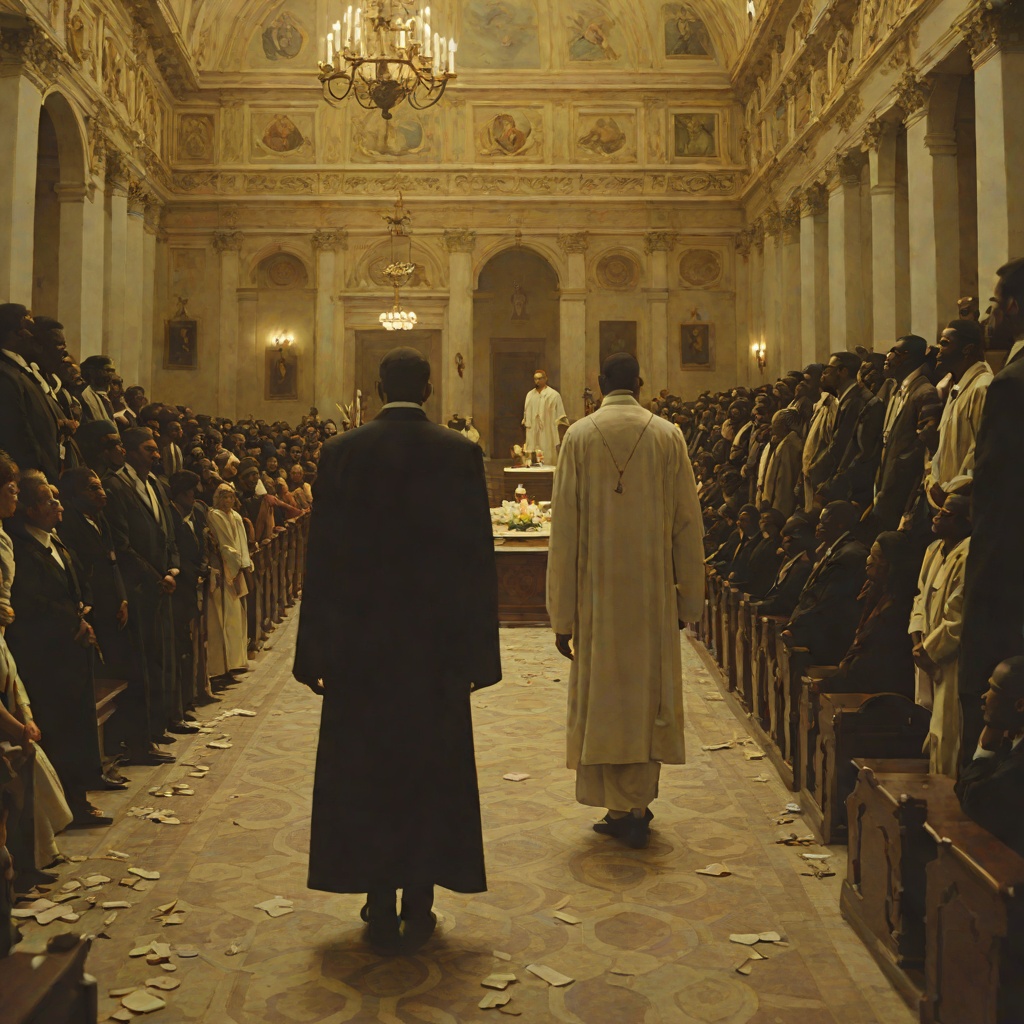
Mikvah
City of GodThe Mikvah, the ritual bath of Jewish tradition, appears in E. L. Doctorow's City of God as a concrete, bodily test of faith that the novel's narrator, Thomas Pemberton, a former Episcopal priest, insists on undergoing as part of his conversion to Judaism. In a faith that the novel presents as relentlessly intellectual—an "Evolutionary Judaism" that subjects every practice to modern scholarship—the mikvah stands out as a stubbornly physical, almost pre-rational act. Pemberton's embrace of it, and his wry, self-aware commentary on the ritual, reveals the deep ambivalence at the heart of his spiritual journey: a man who has spent his life questioning doctrine, yet who craves a transformative experience that bypasses the intellect entirely.
The Ritual and Its Place in Conversion
The mikvah is introduced in the context of Pemberton's conversion studies, which he conducts with a rabbi other than Sarah Blumenthal, the woman he loves and who is herself a rabbi. The novel notes that this immersion is "another conversion ritual less assiduously held to by the Reformed," marking it as a practice that the more liberal branches of Judaism have allowed to lapse. Pemberton, however, wants to do it. He describes the ceremony with a mixture of reverence and characteristic humor: "In front of three witnessing rabbis you duck yourself naked in the pool, and when you come up you're reborn as a son of Abraham." The image is deliberately vivid and slightly absurd—a grown man, naked, dunking himself in a pool before witnesses—and Pemberton is fully aware of its strangeness. Yet he finds in it a profound comfort, calling it "a dissolving Christian" and adding, "Has a nice Baptist quality." The joke is telling: even as he leaves Christianity, he cannot help but see the new ritual through the lens of the old, finding in the mikvah an echo of the Baptist immersion he knew from his own tradition.
Pemberton's Motivation and the Question of Sarah
The question of why Pemberton converts—and how much of it has to do with Sarah—hangs over the entire process. When asked directly, "Pem, tell me truly, how much does your converting have to do with wanting to marry Sarah?" he answers with a paradox: "She has everything to do with it. And nothing. I don't like the question." The mikvah, as the most physically demanding and ritually specific element of his conversion, becomes a test of this ambiguous motivation. It is the one act that cannot be performed for Sarah's sake alone; it is a private, bodily commitment that he must make for himself. His insistence on undergoing it, despite its optional status in the Reformed tradition, suggests a genuine desire for transformation rather than mere accommodation. The fact that he was "profoundly grateful to have been circumcised as an infant"—sparing him what he calls "one hell of a test of the faith"—only heightens the significance of his voluntary submission to the mikvah. He could have skipped it, as many do, but he chooses not to.
The Mikvah and the Novel's Broader Themes
The mikvah resonates with the novel's larger preoccupation with ritual, sacrifice, and the body. The narrative repeatedly returns to the idea of giving up a part to save the whole, as when Pemberton reflects on the lizard that leaves its tail in the mouth of a predator, or the fox that chews off its own foot to escape a trap. The mikvah is a gentler version of this logic: a ritualized surrender of the old self so that a new one can emerge. It also connects to the novel's exploration of performance and transformation. Pemberton's conversion is, in part, a performance—he will stand before witnesses and declare himself a Jew—but the mikvah is the one moment where the performance becomes physical, where the body itself is asked to participate in the change. In a novel filled with sermons, songs, and ceremonies, the mikvah is the most intimate and least verbal of rituals, a silent act of faith that speaks louder than any of Pemberton's eloquent doubts.
The Wedding and the Completion of the Journey
The mikvah's significance is fulfilled at Pemberton's wedding to Sarah, where he stands before the assembled guests, his double-breasted blazer hanging open, his tie loosened, his forehead "triumphantly cowlicked." He tells the room that he will "soon be a Jew" and that he will "find the joy of a hallowed life." The moment is the culmination of the journey that began with his decision to undergo the mikvah. His final act as a Christian priest is a prayer that is less a blessing than a reckoning—a furious address to a God he accuses of being "part of the problem," a God who has been "bought and embraced like the lowest, most pathetic streetwalker." The prayer is his last word as a Christian, and it is a word of anger and disillusionment. The mikvah, by contrast, is his first word as a Jew—a word spoken not in language but in water, a silent immersion that washes away the old self and prepares him for the new. It is the one ritual in the novel that offers the possibility of genuine rebirth, a promise that the body, at least, can be made new even when the mind remains troubled.